8. 1851: Overview
In 1851 no more than 5% of the land area of the parish was occupied by houses and their immediate gardens. The greatest concentration of cottages was on the north edge of Prestwood Common, especially the group called Cabbage Row along what is now Kiln Road. Some houses extended east to Martin's End and were scattered down the east side of the Common, while there were scattered residences at Hotley Bottom and Honor End in the far north of the parish. A few habitations were scattered along what is now Wycombe Road, along the west side of the common, extending through Collings Hanger Farm and the new Church to Peterley Corner. Another sizable group of cottages surrounded Kingshill Common in the south and there were small groups at Peterley Manor and Heath End. There was no community as such at Bryants Bottom, although two cottages existed in the valley there, and there were several more above on Denner Hill. (Bryants Bottom gets its name from “Brian's House” which was actually just outside the parish boundary north of the present community, where there were four earlier cottages.) Two cottages existed at Stony Green.
The economy of the area was very much based on farming. Improved methods, including the fertilisation of fields with chalk from pits dug through the surface layers of clay, had led to increased yields compared with previous centuries. Most men worked directly in farming, largely as employed labourers, but also in ancillary trades such as blacksmiths and wheelwrights. Other industries included lace-making and straw-plaiting (women’s occupations, carried out at home), wood-working (felling and cutting timber, and turning chair-legs for the furniture industry in Wycombe), the extraction of Denner Hill stone, and brickmaking. The former kiln at Nanfans, active in the early C19th, was already abandoned, but there was still one on Kiln Common by Cabbage Row. Other men provided general community services, such as the selling of beer or other goods like bread and groceries.
Prestwood Common, including its south-eastern arm down to Peterley and its north-western extension into Kiln Common, occupied 120 hectares, while sizable commons also existed at Great Kingshill and on Denner Hill. Altogether, common land made up 15% of the land area of the parish. It had long been a vital resource to local residents as a source of grazing and firewood and so on, which is why most of the cottages were situated around its borders. These commons were primarily acid or neutral grassland with stands of gorse and frequent ponds for watering stock (about 70 ponds existed in the parish in 1851).
17% of the parish was occupied by woodland, and a further 1% by an area of scrub known as Nanfans Green. Apart from a few areas where alien pine and larch had been planted as quick-growing timber, the bulk of this woodland was planted beech, replacing the earlier mixed deciduous woodland for the sake of the furniture industry. A particularly large swathe of woodland stretched from the north-western corner of the parish (now a field known as Stony Bank), following the hillcrest to the east of Hampden Road as far as Hughenden, with only a few small gaps.
This left over 60% of the area cleared and drained as farmland, mostly arable with some permanent pasture largely adjacent to farmsteads. The main produce was grain - wheat, oats and barley (to a lesser extent rye), and pulses, supplemented by root crops from the C18th onwards. It was some of this farmland, small pastures belonging to Nives Farm, that was transferred to the new church as glebeland, including the area where the church, the rectory, the new school and the churchyard were built, and a large field to the west which subsequently became known as Prestwood Park. Most farmers at this time were tenants, paying annual rents to landowners, most of whom resided outside the parish. This was typical of the country generally at this time – Eveleigh (2002) states that “Almost 90 per cent were tenants” in the C19th. In so far as there were independent owner-occupiers, the great majority held only small farms of a few acres, usually to supplement their income from some other occupation, and therefore no different in their social position to other local artisans like blacksmiths and builders, having a certain independence, employing one or two men, and managing to amass sufficient capital to afford an acre or two. Some of these small farmers, indeed, worked from time to time as paid labourers on the larger farms. Even those full-time farmers who worked moderately sized farms of, say, 50 acres were described by Aylesbury farmer J.K.Fowler (1892) as little different from the labourers they employed, working beside them in the same clothes, assisted by their wives and children, only making enough to get by – “going on from cherry time to cherry time and getting no forwarder”. If they lost their tenancies – and here they were in the palm of the landowner – they had no capital to carry forward other than their own labour.
The principal farmers, who would have been some of the leading people in the community at the time, were not local to the area. Indeed, eleven of the sixteen on whom we have information had been born outside the immediate area. Some came from nearby parts of the county – Great Hampden, Monks Risborough, Wendover, The Lee, Little Missenden, and Dinton – but two came from Hertfordshire, one from London, and one from Oxfordshire. While farmers’ sons may have tended themselves to become farmers, they as often as not moved to other parts, and there is little sign of farms being handed down from generation to generation for any extended period – a fact which has generally remained true to the present day.
While farming provided most of the employment in the area for men, another local source of jobs – especially for young single women - was the small group of families wealthy enough to employ servants. The wealthiest in the vicinity was undoubtedly Hampden House, no more than a kilometre outside the boundary, then occupied by Lord Donald Cameron and his wife Lady Vere. They employed 12 servants, including a cook, gardener and lady’s maid. Only two of these, however, were local, four being from elsewhere in the south-east, three from further parts of England and two from Cameron’s original home in Scotland. Although at any one time only one or two local people were generally employed as servants, the impact was much wider because such employment was usually short-term and there was annual turnover in those who held these posts, because these were primarily temporary places for teenagers before they married (usually in their very early twenties).
Local rectors appeared to have quite expansive needs in the way of domestic help, presumably because they themselves had to concentrate on things more spiritual. Their large families, too, would have created a not insignificant burden on the parents. The Revd. J.R. Pigott at Hughenden Vicarage supported a wife, seven young children, and a retinue of five servants – a governess, nurse, cook, nursemaid and housemaid, two of whom were local women. Revd. Charles Lloyd at Great Hampden Rectory similarly had to support a wife, widowed mother and six young children and therefore required a similar domestic workforce of seven servants (a cook, nurse, parlour maid, two nursery maids and two housemaids), of which again two were born in the immediate vicinity. Prestwood’s own curate, Revd. Thomas Evetts, was rather younger (30 years) and in 1850 only had a wife, widowed mother and four very young children (all under five) to support. Even so, he required an equal retinue of seven domestic servants, of which only one was from Prestwood and most from areas of the country, such as Oxfordshire, where he had previously lived. Such a number of servants was unusually large for such a small household (as can be seen by comparison with the table in paragraph 55 of Thorpe, 2002, where clergy households of seven persons in 1851 averaged 2.5 servants). This perhaps reflected Evetts’s wealth or ambition, or both. His wealth is certainly unquestionable – the forming of a new parish, at the behest of Bishop Wilberforce, cost him in “buildings and glebelands”, it is estimated, “more than a million pounds in present-day terms” (Keen 1998a).
The only other households in Prestwood employing the odd domestic servant were, with one exception, a few of the farms and the public houses. (The exception was retired army pensioner John Essex who lived on Prestwood Common, employing one male servant.) Excluding those male servants who were live-in agricultural workers, only three farms had more than one domestic servant. Dennerhill had four, Andlows Farm had a housekeeper and two other servants, and Atkins Farm three servants. Other farms with one servant were: Moat Farm, Collings Hanger, Knives, Pipers Corner, Newhouse, and two in Great Kingshill just outside the parish boundary, Sladmore and Hoppers. Half of these servants were from the immediate vicinity and the others generally not from far away. Three public houses each employed one servant – the Chequers, Polecat and George (the last an “errand boy”).
Given the limited population of the time, it is remarkable how many inns Prestwood could maintain. (One has to remember that water and milk were frequent carriers of typhoid and TB in these days; beer was actually a much safer drink and able to be brewed quite cheaply. Beer and cider were the drinks traditionally provided by farmers to workers at harvest time.) These beer-houses were relatively small affairs on the whole, and did not provide full-time occupation for the publicans. While some of those on main roads and in the main areas of habitation may have hosted drinkers, one has to remember that labourers of that time worked very late in the day and would have had little time for an ‘evening down the pub’. For the most part beer was sold to visitors bringing their own jugs to take away for consumption at home or in the fields. Given the small population on Denner Hill, for instance, it does not seem likely that the Weathercock there could make a living out of the local residents, but there was a daily influx of farm labourers and workers of Denner Hill stone who contributed to its custom.
Three inns existed in the main community north of the common: The Chequers which was actually on the common itself, near its northern boundary (and north of the site occupied by the pub of that name today), The George at Hotley Bottom (now part of a private residence), and the Green Man at Martin's End. On the western side of the common north of Collings Hanger Farm, near Chestnut Farm, was the Golden Ball, of which there now remains no trace. Near Peterley Corner, just south of the new church stood both the Polecat and the Kings Head (since demolished and rebuilt). At Great Kingshill was the Stag or Rising Sun (now a private house), and at Heath End the White Horse (recently demolished for new housing). In addition, William Collins, who owned Hoppers Farm in Great Kingshill (but outside the parish boundary), lived in a house on Kingshill Common near Hatches Farm, from which he sold beer. Within a decade this was to become the Red Lion pub. The Weathercock sold beer on top of Denner Hill, and the Harrow down in the valley below that separated the hill from the Prestwood plateau.
Thanks to the 1851 census we can get an almost precise picture of the population at this time. A limitation to such a census is that it includes only those individuals who are in residence at one particular time when the census was taken. It thus includes temporary visitors from elsewhere and excludes permanent residents who happened to be out of the area at the time. Given the limitations of travel at this time, however, the amount of this kind of daily migration was very limited. It therefore has no impact on our ability to draw conclusions about the nature of the population, except possibly for some richer families, who may have been in their “town houses” in, say, London or Oxford.
In 1851, then, there were apparently 187 households. Some of the poorest of these shared accommodation, so that the number of dwellings would have been something less than this figure. The number of individuals totalled 844, an average of 4.5 persons per household. Given the small size of most of the cottages at the time (as can be seen from the few that survive) and that some households shared dwellings, one can conclude that space and privacy were scarce commodities. The population density (individuals per hundred acres) was also higher in Prestwood (42) than in Buckinghamshire as a whole (36 according to Thorpe 2002), closer to the figure for Hertfordshire (41). This probably reflected increasing population density as one approached London, the major market for agricultural produce.
Many of these individuals were, of course, young children and babies. The birth-rate was high – thirty babies had been born within the past year: one for every sixth family. With low standards of hygiene and comfort for the bulk of families, the survival rate for these babies was not high. The average age cohort among teenagers was about half the figure for births, indicating that only half of these babies were likely to survive beyond childhood. They would have been particularly prone, given the overcrowding, to any epidemics that spread across the country, even though the worst impact of both was felt within the towns and cities and not in the countryside. While numbers of children in Prestwood aged between 1 and 11 averaged about 20 per year-cohort, there is a surprisingly low figure of 13 three-year-olds that stands out. It may have been chance, but one might speculate that a wave of some epidemic – perhaps cholera? – could have hit Prestwood up to three years before the census, taking nearly half the babies born that year.
Lower life expectancy is clearly shown by comparison with figures for the present day. Only 4.5% of the 1851 Prestwood population was over 65 years, compared with over 13% today. Similarly, half the population was aged under 25, while today one would have to go up to 35 to include the same proportion. The number of widowed spouses was also high. There were even two in their twenties, and the rate gradually rose from 5% of the thirties, to 10% of the forties, 16% of the fifties, 20% of the sixties, up to 60% of the over-70s. (While high death-rates would have occurred partially from disease, some men were recruited as soldiers and killed in the frequent foreign wars of the time. Some men may also have been executed or deported for poaching or taking part in Luddite riots.) In one respect, however, old Prestwood seemed to be bucking the usual trend. Normally women have a higher life expectancy than men, but in Prestwood in 1851 there were more men than women aged 70 or more, and three of the four people in their eighties were men. One could expect the long-term effect of continual child-bearing would have been severe - the usual distance between children's ages in one family was one to two years. Birth control was not a concept of that time.
Marriage was normal for those who were 30 or over, while half of those in their twenties were also married. 83% of people in their thirties were either currently married or had been married, and over 90% of older people were in that position. On the other hand, people seldom married before their twenties – only one such person at the time of the census, out of 37 aged 18 or 19. Marriage meant that the couple had to maintain themselves independently of their families of origin, through their own work: very few continued to share accommodation with their parents.
The modern pattern of nuclear family households was therefore already well established in the Prestwood of 1851. Of the 185 households on which we have the details, 40% were composed of nuclear family only (husband, wife and children). A further 12% were simply married couples (usually very young and yet to have children or older couples whose children had grown up and left home). Widowed parents with their children comprised a further 12%. Thus only a third of households departed from the basic nuclear family norm. Most of these, moreover, were nuclear families (or single-parent families) with other relatives (13.5%) or lodgers (including servants). There were only eight single-person households in the entire parish, in three cases with a live-in servant. Finally, two single persons lived with a lodger, two with a relative, and there were two households each composed of two sisters. It is therefore clear that individuals without their own families almost entirely took up residence with others, either as relatives, lodgers or servants.
A floating population of single adults was therefore supported by the families in the area and also, in most cases, constituted an important economic resource for those families, able from their own employment to boost the household budget. Excluding a few temporary visitors, 133 residents of the parish were neither household heads (including single persons) nor nuclear family members. Of these, 64 (almost half) lived with other relatives, such as a child’s family or a married sibling. 27 persons were “lodgers”, in other words living with unrelated families, while the remaining 42 were servants or live-in employees of their hosts. This substantial system of lodging out was vital for several reasons. It included, for instance, several elderly people who would have found it difficult to support themselves. By far the largest category, however, comprised younger people who had yet to marry – in their teens or early twenties. Often from families with many younger siblings, they would have relieved the chronic overcrowding, while contributing support to other households in a different stage of life, when there were fewer hands to bring in extra money or help with chores. The employment of servants provided a further way by which those with money were able to support less well-off families, in return for relief from chores (that would have been very much more laborious in those days than they are in our era of electricity and chemicals). The lack of labour-saving devices meant that the simple task of just maintaining house was a massive chore that dominated the lives of housewives and unmarried daughters.
The reliance of the local economy on agriculture at this time is clear from the breakdown of the occupations of all the male heads of households in the census. Of the 172 who were not simply designated as “retired”, over half (91) were employed in agriculture. The great majority of these (74) were agricultural labourers, the other 17 being farmers.
The local woodlands were another prominent resource, almost a fifth of occupations of male heads (34) being connected with the timber trade. Sixteen of these were sawyers, seven carpenters, four chair-turners (“bodgers”), two woodmen, two timber dealers, two cart saddle-tree makers, and one timber valuer. Most woods even today show the signs of these activities. Pits about 8mx4m, the earth removed banked up on the down-slope side to bring it level with the upslope rim, were saw-pits used to cut larger timbers, a large saw being yielded by two men, one stood below in the pit and the other standing above. (As described by Rose 1937, the logs were cut lengthwise into planks, guide-lines being provided by stretching long strings soaked with lampblack and water along them to leave a straight black line. The heavy logs were moved entirely manually using age-old techniques of levers and “ring dogs” to hold the log in position.) Large trees now growing inside or on the edge of these pits would not have existed at the time of use and can be used to provide a latest date at which such pits were used, usually 1900 or earlier.
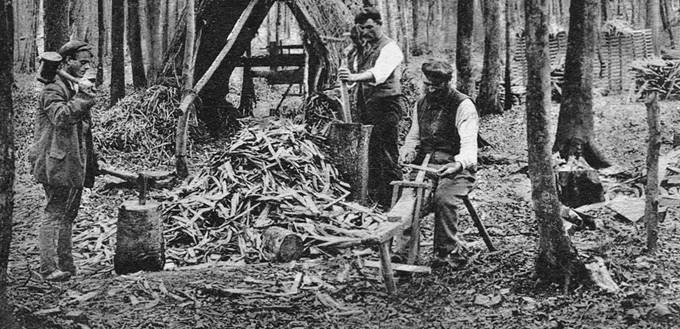
Bodgers in Prestwood c1910
Bodgers, on the other hand, employed thinner wood cut from young beech, but they still worked within the woods themselves. They made chair legs on home-made pedal-operated lathes, themselves purpose-built out of local wood. The lathes had a rope attached to a long branch under tension and wrapped around the axle of the lathe. No mention is made in the census of charcoal-burners, but we know they existed at this time because the remains of charcoal-hearths, the shallow level platforms on which the kilns were constructed, still containing fragments of charcoal if one digs beneath the later accumulation of leaf-mould, can still be discovered in several woods. This job must have been combined with other wood-working occupations, as it was probably never a major source of income in this area, where the woods are predominantly on clay. “Warmer” light chalk or loam soils were preferred to provide a quicker “burn”. It was also a job for the summer and autumn months, and woodcutting was a natural alternative for the winter, when the sap was not rising. Charcoal-burning was a skilled job and stack-kilns (more advanced than the pit-kilns of earlier times) needed constant attention, so the burners lived on site in the woods, often with their families, in rough turf-covered huts of wood and sacking, and many were itinerant, moving from village to village, which may have been another reason why none of the residents of the parish were described as charcoal-burners. In any case, the heyday of small-scale woodland production had been largely replaced in the C19th by industrial processes in brick-built kilns near the factories that used the charcoal (Kelley 2002).
Surprisingly, the brickfield at this time did not maintain many families; indeed, only two households were those of “brickmakers”, while the cutting of Denner Hill stone maintained just one household from within the parish.
Nine per cent of all male heads (15) were dealers of some kind, nine being publicans or beer-sellers, three grocers, two general dealers and one a spirit merchant. A further sixteen were skilled tradesmen: five blacksmiths, three wheelwrights, two bakers, two shoemakers, a butcher, a last-maker, a millwright, and a rope-maker. Nine were non-agricultural labourers (building, roads, gardening etc). Finally there were two carters or carriers, and just two from the white-collar class – the curate and a professor in his country house.
This picture is confirmed by the breakdown of all occupations, whether or not household heads. Of the 303 jobs recorded for males, 180 (59%) were based on agriculture, including 156 farmhands. (This should be compared with an average of 37% for Buckinghamshire and 15% for the whole country – see Thorpe 2002.) Fourteen per cent of males were connected with the timber industry, including 21 sawyers. Twenty-five worked in skilled trades, including apprentices; nineteen were non-agricultural labourers; seventeen were dealers or publicans; and ten were house-servants.
By far the greater part of men’s occupations, then, were dependent on the local economy. The same, however, does not apply to the women. Two major facts about female employment are immediately apparent: the majority of women worked, and their jobs are wholly distinct from those undertaken by men.
Of the 281 women in the census apart from the very few recorded as retired or as “paupers”, only 85 (30%) were not recorded as having an occupation. All the unemployed women were married, most of them looking after children. The data, however, show no association between wives’ employment and the occupation of their husbands, their ages or the number of children, as one might have expected. The major difference between working and non-working wives was where they lived! Those in the sections of the parish that were part of Great Missenden civil parish (the eastern half from Moat Lane south to Heath End) are almost wholly (89%) recorded as having no occupation, whereas two-thirds of those in the other sections are recorded as employed. Such a large difference between people who are such close neighbours would seem to be unlikely, and it is probable that the census officials in different (civil) parishes operated with different rules about what they recorded as they went from house to house, the person in Great Missenden perhaps routinely recording married women as ‘housewives’ and not asking for an occupation. Whatever the explanation, records of wives’ employment in this census must be regarded as unreliable, and one cannot assume that failure to record an occupation meant that they did not have one. On this basis the percentage of women working must be taken as a minimum and almost certainly a substantial under-estimate. As they stand, the census data show 41% of married women to be employed, whereas the figures from the civil parish sections other than Great Missenden would indicate a more likely figure of 66%.
Such a figure would show a situation with regards to ‘working mothers’ not at all dissimilar to today. There is one major difference, however. In 1851 women’s occupations were almost all carried out at home, the so-called ‘cottage industries’, which meant that they were more compatible with other domestic chores and child-rearing. Women worked, but they did not ‘go out to work’. Given the length of time taken up by domestic drudgery in those days, and the fact that most of the men, working on the farms, would be away for very long periods, from sunrise to sunset, the cottage industry was really the only way in which house and family maintenance could be reconciled with the need to bring in enough money. And money was desperately needed, for agricultural wages were not enough to keep a family (7 shillings a week – the cost of a bushel of wheat, as against the urban factory worker on 11s.6d. – Clapham 1950).
The second fact, that women’s employment was almost entirely separate from the world of men’s work, is one that is much less evident today – not wholly perhaps due to the rise of sexual equality, but also to the sober economic fact that traditional men’s occupations in rural areas have been those most subject to decline. Today in Prestwood you will have to seek hard to find an agricultural labourer, sawyer or an exponent of any of the skilled trades of the 1850s. As new occupations arose, women as well as men, liberated by technology from the tyranny of domestic chores, were recruited to them. In 1850, however, women’s jobs were not only distinct, but also largely involved earnings from outside the village.
Foremost of these cottage industries, and the one that accounted for more than three-quarters of all women’s jobs in the parish (154 altogether, representing 18% of the total population) was lace-making. Both the threads and the patterns made of parchment were purchased from buyers from outside Prestwood (eg Great Missenden, High Wycombe). These middlemen had a monopoly on the purchase of the final products for selling on to London and elsewhere. The relationship was exploitative and the women poorly rewarded for what was hard tedious work, over long hours and without a holiday other than the lace-makers’ annual day-off on 25 November (St Catherine’s or Cattern’s Day, after both the patron saint of spinners, weavers and lace-makers, but also after Katherine of Aragon, not just one of Henry VIII’s victims, but also a practiced needleworker who lived in the north of the county during the 1530s and both introduced the skills to England and encouraged the local industry by her own patronage). This holiday was also known as Candle Day because the date marked the time when there would no longer be sufficient daylight for lace-making, and the occupation would have to take place in candlelight, groups of women sitting around a single candle equipped with a glass reflector to concentrate the meagre light. The day’s celebrations included lace-making pupils having to jump over a lighted candlestick (difficult in long dresses and petticoats), as well as Catterns, cakes baked with caraway seeds, and bowls of hot spiced cider. In cold weather warming-pans known as "chaddy pots", filled with hot coals, were tucked under the ladies' skirts.
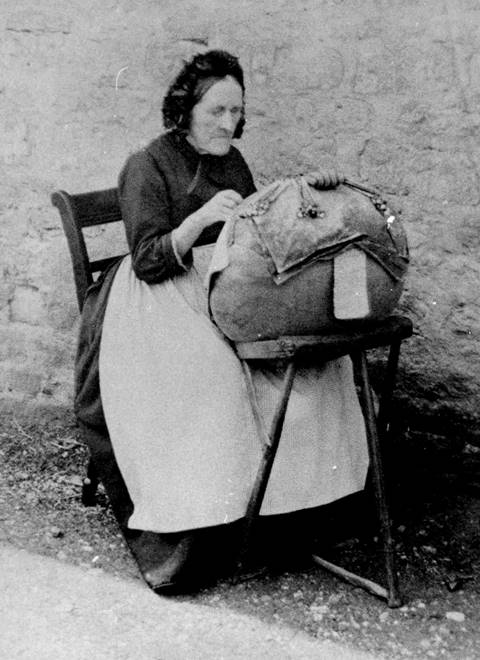
Buckinghamshire lace-maker
The lace-maker pinned the pattern to a large cushion resting on her knees, the pins located in the holes of the pattern, and threads on bobbins were wound round the pins in complicated manoeuvres. Photographs from the nineteenth century generally show the lace-makers sitting in the doorways of their cottages, presumably to catch a better light, that would have been very dim within these cramped buildings with their small windows. Much skill was involved and specialist village communities formed, as early as the C17th, in the counties of Buckinghamshire, Bedfordshire, Oxfordshire and Northamptonshire, where the bulk of the women plied this trade and passed it on to their daughters. (There was a lace-buyer in Great Missenden, William Statham, who died in 1685, according to Hepple & Doggett, 1992.) Prestwood had long been one of these communities, and no doubt local women contributed to the display of local laces at the Great Exhibition in London in 1851. Apart from the lace-makers themselves, there was also one woman in the parish employed as a “parchment pricker”, a person who created the patterns, following assigned designs.
The fashions of the times required not only large quantities of lace, but also hats made by plaiting straw. Straw-plaiting was another skilled cottage industry, in this case concentrated in the counties of Hertfordshire, Essex, Bedfordshire and parts of Buckinghamshire, serving the hat industry in Luton. Prestwood therefore fell within both the lace-making and the straw-plaiting regions, and there were 21 women employed at plaiting in 1851. While lace-making was sedentary, straw-plaiting did not require quite the same level of skill and could be accomplished while moving about, the straws tucked under their arms and held in their mouths to soften them. The straws chafed the hands and made them very sore. The money earned could equal that of their farm labourer husbands (up to £1 a week), but only at the expense of long hours (12-14 a day, according to Hay & Hay, 1971) and repetitive work. Poverty might tempt both plaiters and lace-makers to work extended periods, neglecting, it was reputed, domestic and family responsibilities. Straw-plaiters, moreover, had a reputation for “loose morals” that brought their trade into low esteem, although insofar as there was an association between this craft and poor communities, it is most likely that poverty and lack of education were at the root of this reputation rather than anything else. (For a graphic description of the problems of rural poverty in the first half of the nineteenth century, see Hudson, 1936.)
Both lace-makers and straw-plaiters were serving the great industry of Victorian fashion, and so were the eight dressmakers who also lived in Prestwood, as well as a ladies’ cap-maker, a needlewoman and a “fancy basket-maker”. Altogether 93 per cent of all employed women in Prestwood in 1850 were serving the fashion industry. Apart from them the main job opportunities in the area for women were as domestic servants, of which there were 21 in the parish. A few assisted their husbands who were shopkeepers or tradesmen, there were two schoolmistresses, and a few other miscellaneous jobs ranging from midwife or nurse (neither of which implied any formal qualification as they would today) to laundress. Farmers’ wives were described in the census as just that: although not formally paid, they nevertheless had full-time jobs, often carrying out manual work on the farm, and even in the wealthier cases having the management of the household, often of numerous servants, in their care, as well as the domestic aspects of a farm such as tending the poultry and running the dairy. Their unmarried children, too, if still at home, were heavily involved in farm work, normally described in the census returns under occupation as “farmer’s son” or “farmer’s daughter”.
Entry into work occurred far earlier in those days than in ours. Apart from some kind of employment, the census also used the terms “child” and “scholar” to refer to younger people who did not work. Up to the age of three, all are referred to as children. Although this designation is also applied to some young people up to 13 years of age, it becomes increasingly infrequent above the age of three. The youngest “scholar” is aged four, but this also is the age of the youngest person said to be in work, a straw-plaiter. This was exceptional, however, as the next youngest workers were all aged six – a straw-plaiter, a lace-worker, and a farmhand. As the tables below show, girls started work earlier than boys (over 40% of girls aged 7-8 were working, and over 60% of the 9-10s, as against 15% and 32% of boys of those ages), while everyone aged fourteen or more was in work, with the exception of two boys of 15 and 17, both sons of the wealthy farmer at Atkins Farm.
Boys by occupation, 1851 census
Age |
Child |
Scholar |
Employed |
|
0-3 |
100% |
- |
- |
|
4-5 |
83% |
17% |
- |
|
6 |
45% |
45% |
9% |
|
7 |
43% |
43% |
14% |
|
8 |
33% |
50% |
17% |
|
9-10 |
36% |
32% |
32% |
|
11-13 |
6% |
12% |
82% |
|
14-17 |
- |
6% |
94% |
Girls by occupation, 1851 census
Age |
Child |
Scholar |
Employed |
|
0-3 |
100% |
- |
- |
|
4-5 |
73% |
23% |
3% |
|
6 |
38% |
31% |
31% |
|
7 |
25% |
33% |
42% |
|
8 |
18% |
36% |
45% |
|
9-10 |
6% |
31% |
63% |
|
11-13 |
11% |
26% |
63% |
|
14-17 |
- |
- |
100% |
At the maximum, only just over a third of all girls were attending school (36% of the 8-years-olds), whereas half of all 8-year-old boys did. More girls were employed than described as either scholars or children at the age of seven or more, whereas this applied only to boys aged 11 and above. Even those said to attend school were very often taken out of school to serve the demands of seasonal work when more hands were needed, for bird "startling" in the orchards, fruit picking and the hay harvest.
The domination of work in this community cannot be over-emphasised. It started by the time you were ten or so (and often before), was physically hard and tedious, lasted long hours, six days a week, and only ended when you were too feeble to continue. 86% of people in their sixties were working, 71% of those in their 70s, and even half of those in their 80s. The average person gained less than three years' schooling in their life, and many never went to school at all. Those who went to school, moreover, were not a random selection of the population. 80% of trades-people’s children attended school, but under half (48%) of children from unskilled workers’ families (predominantly, of course, agricultural labourers). In this respect, sawyers must be placed with the skilled trades, as six out of seven of these families had children at school. (This is probably because of the association of wood-working occupations with Dissenting families, where there was an emphasis on literacy.) While the class bias of these figures is obvious (and it was even more severe for girls than for boys), one can also take some heart from the fact that nearly half of unskilled workers did manage to send some at least of their children to school for a while.
There was little chance, then, that most children would do other than follow in the footsteps of their parents, a fact confirmed when we look at the occupations of unmarried children over 13. In those families of agricultural labourers with sons of this age still living at home, the eldest in every case but one (out of 24) was also an agricultural labourer. The exception was a relatively young child working as an errand boy, just a temporary occupation. Similarly for girls in households where the mother was a lace-maker or straw-plaiter, 86% had the same job. Only one out of five farmers’ sons was not working as a farmer or for his father. More of an exception is provided by the skilled trades, where only half the sons (5 out of 10) were working in the same trade as their fathers. Two were working at different skilled trades, one was a teacher, and the other two were agricultural labourers.
The census data also enable us to see how mobile the rural population in the area was in the middle of the nineteenth century, as the parish where each person was born was given. Because Prestwood as an ecclesiastical parish was divided between the three civil parishes of Great Missenden, Hughenden and Stoke Mandeville, all of which extended beyond its boundaries, we cannot tell whether or not individuals were actually born in Prestwood, but we can at least see what proportion were born in these three parishes. While most of these would probably have been born in our area, they would include some born outside the ecclesiastical parish in neighbouring villages. Out of 831 recorded birthplaces, 589 or 71% were in the three immediate civil parishes. This compares with about 58% born in their home or neighbouring parish across the county as a whole (Thorpe 2002).
The greater number of the remaining persons were born in nearby parts of Buckinghamshire (160, 19%), particularly Great and Little Hampden, Chesham, Little Missenden, Princes Risborough, Monks Risborough, Wendover and The Lee. (Interestingly, only six came from High Wycombe, the nearest town, less than five miles away. This would accord with the fact that this was a time of substantial urban expansion, with most urban-rural migration going one way.) Only 10% of the Prestwood population were born further away than that, more or less equally split between other parts of Buckinghamshire, neighbouring counties, and other parts of South England. Three-quarters of Bucks residents at this time were born in the county (Thorpe 2002), as against 93% from Prestwood, which therefore seems to have been a more closed community than most.
The above statistics might minimise the amount of migration, however, because they include younger children who were very likely to have been born locally, even if their parents had immigrated from elsewhere. Taking male heads of households only, the figures for the home parishes is indeed somewhat less at 58%. Female heads and wives of male heads indicate a similar proportion, 59%. In other words, over two-fifths of all households originated from outside Prestwood. 29% of the male heads and 23% of the female heads came from neighbouring districts, while 13% and 17% respectively came from further afield. This gives a better idea of the amount of migration going on at the time, which was fairly substantial, even if mostly over short distances. Even so, mobility in other parts of the county was still considerably higher.
Most occupational groups showed rates of in-migration close to the average, except for the farmers, of whom only one quarter came from the local parish, and about a third even came from beyond neighbouring areas. (This was an exceptionally high rate of mobility – figures in Thorpe (2002) indicate that just over half of all farmers generally in the county were born in their home or neighbouring parish. It is not clear why such a considerable change-over in Prestwood’s farming families occurred in the early C19th.)
Two groups, on the other hand, exhibited particularly high rates of local provenance – agricultural labourers (65%) and dealers (69%). These findings also contrast with those for the county as a whole (Thorpe, 2002), where agricultural workers were even less mobile (79% from home or neighbouring parish), while dealers (eg publicans, grocers) were much more mobile than the general population. The higher-than-expected influx of farm workers into Prestwood in the first half of the C19th may have been associated with the changes in farm ownership that occurred at the same time, the enclosure of Kiln Common, or a drop in the resident adult male population due to some unknown cause.
“Lodgers” were generally quite local in origin (61%), except for servants, as noted above, of whom only 40% were from the parish, and 38% came from beyond the local district altogether.

Example of a page from the 1861 census for Prestwood