Part V
Chapter 13 A History for the Future: Unlucky for some?
“And the things you young people are going to see!” Mrs. Thornbury continued. …
“When I see how the world has changed in my lifetime,” she went on, “I can set no
limit to what may happen in the next fifty years.”
Virginia Woolf “The Voyage Out” 1915
This book has been, by and large, a record of change. Prestwood is no longer the place it was, but then the world of which it is, and always has been, very much a part has also changed incredibly since 1850, when the story of Prestwood as a distinct parish begins. Given the massive change that just fifty years has brought in the past, what can one hazard as to the next fifty?
A millennium ago Prestwood was a wild forest that the Saxons began to tame, building the first farms. Medieval times saw the felling of much of the remaining forest, leaving more or less those patches of woodland seen today. Until the C20th Prestwood remained a rural economy based on two main resources – its trees and its farmland. Right up until the second world war it could still be seen as primarily rural, although expansion of residential housing had already started.
By the end of the C20th, however, much of the aspect of the area was suburban rather than rural, and the rural, consequent on changes in the economics of traditional farming, was under siege. Already the abundant wildlife that had grown up, if not always in peaceful co-existence at least in uneasy compromise, with farming, was vanishing in the middle of the century (as in past centuries the wilder creatures like the wolf, the polecat and the red kite had long been eliminated). Meadows of orchids and butterflies are fading memories that these days seem like unrealistic dreams. They did really happen, but whether we can reconstruct that part of the past is an open question – it is dangerous to assume one can put the clock back. Nothing can be separated from anything else – soil, climate, wildlife, farming and other economic activity, technology, human activity and human aspirations – and they have all moved on; even, as we saw in the previous chapter, the soils have changed, influenced by our profligate use of chemicals.
One thing only can we be sure of: Prestwood will be what its residents make of it. There are various scenarios to choose from.
According to one scenario, the building boom of the C20th could be resumed, after slowing down in the last two decades. After all, there are pressures from central government to expand housing to serve projected increases in population and the continuing tendency to smaller households. Some argue that such new building should be confined, where possible, to infilling already built-up areas, but towns need their “green lungs” as much as villages, and “wasteland” that seems to be economically unproductive may be very productive as far as wildlife goes, as well as for recreation and “escape” (something we all seem to need more and more as our space and time get used up and therefore more precious). If towns are to be left habitable, some new building at least will have to be on the edges of smaller communities and Prestwood might seem an appropriate candidate. There are Green Belt and AONB regulations, of course, but they only weigh in the balance, they are not absolute prohibitions on development. The green spaces around housing areas soon become impoverished by over-use, and so they come to be devalued and seem ripe for building upon. Farming is currently in crisis. Farmers are giving up and leaving the land. Farmland is therefore likely to come on the market for other purposes more and more often in the future. This would also make more land potentially available for housing.
On the basis of this, quite feasible, scenario, Prestwood could see the area of residential space increased by 50% or more in fifty years. In the process certain unique semi-natural habitats close to existing housing would be lost forever. The pressure on other green spaces from the growth of population and the propinquity of housing would in turn reduce their biodiversity. Further water extraction and soil disturbance would dry out more ponds. More trampling and pollution would reduce the sensitive flowers and increase the coarse plants such as nettle, dock and thistle. Regular disturbance would frighten off much of the wildlife, except for the great opportunists like the grey squirrel and wood pigeon. There would be less countryside, and what there was would be less attractive. Social conflicts, too, would escalate, as more people, with more diverse recreational and leisure needs, come to rely on a decreasing pool of open space. Each would spoil it for the other. Increasing urbanisation would bring more of the urban ills such as litter, pollution and disaffected youth. Houses must be built somewhere. In fifty years it could happen – a string of urban development from Prestwood through Great Kingshill and Cryers Hill to High Wycombe. It is one choice we have.
Whether or not we go down this route will depend on the value that residents generally (not just a few) place on the country environment in which they currently live. The growing concern about environmental conditions and climate change has left its mark among residents. New business ventures like Pantry 51, a green café and "refill" shop, opened on Prestwood High Street in 2020, reflect this new awareness. Many people are "greening" their lives - reducing emissions, saving energy, avoiding waste. These efforts are necessary, but they are not sufficient in the face of lack of action by large corporations and governments. "People pressure" can work - it has led to supermarkets reducing their use of plastics and packaging, for instance. But how far will most people go when it is a matter of making environmental and economic sustainability a top priority for the government, compared to people's very reasonable concerns about income security and personal comforts? The local vote for the Green Party would indicate not very far. Awareness of nature, despite these movements, is at a low ebb. People no longer grow up in relationship with trees and flowers and wild creatures - there are some who cannot tell a beech from any other tree or name more than half a dozen flowers. The population of Prestwood now is an urban one in culture. Most people neither work nor play in the countryside.
Even if we were to mobilise enough people to avoid the first scenario and to safeguard our remaining countryside, a major question still remains, what sort of countryside? The scenery and wildlife of the part of the Chilterns where Prestwood lies was traditionally maintained as a by-product of the farming practices of the times. Small-scale non-intensive mixed farming allowed the hedgerows, woods and patchwork of fields to survive and within them wildlife to thrive. Changing farming practices in the C20th have already reduced the compatibility of farming and wildlife. Other regions of the country (East Anglia, the midlands) exhibit large-scale fields that are a wildlife desert, uninhibited by the thinner soil and challenging contours that have traditionally set limits in the Chilterns. Many of the small farms in Prestwood, in any case, never were viable economic enterprises on their own. We have already seen that in the C19th the smaller farms of just a few acres were only supplements to income from other work – they never could have produced enough to keep a household on farm produce alone. The unreliability of agricultural production and prices from year to year can be balanced out to some extent across mixed crops, but the small farm never had such protection – a bad crop meant no income that year. It is not the viability of small farms that has changed, but the overall economic structure in which they could operate.
Farmers now find it increasingly difficult to earn a decent living. For them farming is in their blood – it is what they want to do – but once their income falls behind their outgoings, they see no choice but to make new decisions. They can choose to become more intensive (if the land will allow), they can sell up (they may be poor in income, but some are rich in capital – the farms, often grand ancient buildings, and the land will bring in plenty of money on which to retire) or they can diversify into new businesses. Many have chosen to sell. Michaelmas, Idaho, Hampden, Pankridge, and Denner – all these farms are no longer agricultural concerns, being private residences or let out to small businesses. Fields have been sold off as horse paddocks, or sometimes left unused. Woods cease to be productive timber resources and are leased out to shooting syndicates or used for sport. Orchards become senescent and are not renewed. Realising their capital, some farmers become hobby-farmers, keeping a house and a small area of land on which to raise a few animals. These things are not necessarily “bad” in themselves. Hobby-farmers can afford to be more interested in conservation when they do not have to make a profit. The reduction in timber production allows woodland trees to survive to become ancient trees. Unused land may revert to semi-natural habitat, “become wild”. Many small-scale decisions by a large number of landowners could radically change the character of the countryside. The problem is that no-one can tell how it will end up, and many of the new owners are not farmers and have no protective interest in the land.
Other farmers have shown amazing entrepreneurship (but our history of the C19th and early C20th has shown this has always been the case). There are growing commercial centres at Peterley Manor Farm (large shop, café, social activities) and Collings Hanger Farm (barn restoration, educational work with schools, small shops, the new Malt brewery), so that diversification can work, at the expense of great effort, and, on the back of that, still preserve the farmland.
There are several other scenarios involving the preservation of our green space, but they will not be equally appealing to everyone. One is that land will gradually be sold off for special activities – a golf-course, a shooting area, a scrambling area, a private estate, a nature reserve, workshops, horse paddocks. Everyone gets a bit – if they can afford it – but it may be difficult to preserve hedgerows that have become meaningless (just as the ponds disappeared when they lost their economic function), to prevent rights of way becoming shielded by tall impenetrable fences from the views that make their use enjoyable, or to maintain permissive paths (where there is no legal right of way). The integration of farming, wildlife and access to the countryside will have broken down and the results will be unpredictable. Wildlife and biodiversity will be the losers to some extent in this scenario, because the new activities on the land may be less compatible, or because the old wildlife corridors have gone with the fragmentation of land-use. (Longfield Wood, for instance, is now owned by five separate people, each with their own interests, and new fences are erected.) Ramblers too may find their activity restricted (even without denying their rights of way).
The alternative to this uncertain scenario depends on residents being willing and able to exert some control over the development of their countryside. It would mean a willingness to exert themselves to defend what they deem worth preserving and to improve what might be better. It would mean being able to develop a comprehensive plan for the development of their own area. Heaven knows there are enough plans around these days – regional plans, local authority plans, national and county biodiversity action plans, habitat action plans, species action plans, development proposals. None of them ever seem to lead to anything - they are put on the shelf as if they were ends in themselves ("thank goodness that's done"). But that makes it all the more important for parishes to develop their own plans, or they will find themselves at the mercy of more general ones that have taken no cognizance of their special interests. Sometimes the wider plans will be beneficial, but it may need local effort to ensure that they do not remain words on paper, but become actualities.
Being able to react systematically to all these other bodies trying to create their own visions of what each area will be like, depends on having a locally agreed vision of how people would like their parish to look and what spaces they want to conserve. Valuable wildlife areas, for instance, like Widmere Field, or an individual pond or orchard, could be invisible to the distant eye of the bureaucratic planner in county hall. Others, like so-called “wastelands”, may not even be recognised for the value they have. They may even be invisible to those bodies like the Wildlife Trust whose intention is to preserve important semi-natural habitats, unless local people find a way of bringing these facts to their attention. By having a prioritised plan, a community will be able to react to central government demands, such as that for more housing, not only by trying to resist them (which ultimately is doomed to fail if national policy remains unaffected) but also by being able to suggest, for instance, areas for housing that would do least damage to the scenic and wildlife resources of the area.
Obtaining consensus on a local plan will not be easy. There are a multitude of visions of the countryside and recreational uses to be satisfied, and trade-offs will be inevitable, but at least decisions could be taken on a conscious basis, rather than being left to chance (which is rarely on our side, as any gambler will know) or to higher powers that have additional interests to satisfy. There are already plans concerned with residential areas, reflecting people's main everyday concerns relating to travel, recreation, vandalism, litter, but no attempt has been made to create a wider vision that addresses our environment as a whole, the major measures needed to create a sustainable future and conserve wildlife and the countryside. Unfortunately, most members or the relevant parish councils (Great Missenden, Hughenden) have never shown much interest in addressing such concerns. There are some places the new environmentalism has not yet reached.
There is another obstacle, too. It is difficult to assume control unless one has resources. Some resources may be volunteer-power – labour for clearing up a site, for instance, or tree-planting. But financial resources will also be necessary. Not too far from Prestwood, quite recently, an ancient woodland came under threat of being cleared and converted into a golf-course. Local residents, concerned to protect their traditional access to a beautiful wildlife area with many ancient trees, organised opposition to the proposal and a fund to raise money to buy the wood on behalf of the Woodland Trust. With the help of the Chiltern Society they were able to raise a million pounds from very many private and a good many corporate donations, too, and were able to purchase Penn Wood to be managed in perpetuity on behalf of its biodiversity and public access. Many people in Prestwood gave to this cause, which excited the imaginations of many. Penn Wood was a very large piece of land, and not all such purchases would require such an investment. Not all pieces of land under threat, moreover, necessarily need an outright purchase: a management agreement with some financial support may be all that is required. Other areas already under public control (local authority ownership) might be managed appropriately with the help of local residents (as Prestwood Nature is attempting at Boug's Meadow in Great Missenden, or in its community orchard and wildlife-friendly garden at Greenlands Lane allotments).
Insofar as valued spaces would be adequately conserved by the continuance of traditional farming, it may be a matter of ensuring that such farming is able to survive. There is growing public support for organic farming, the maintenance of low-intensity traditional methods and the re-creation of the local economy. Given that farmers need to make a profit to survive, however, the viability of such trends will depend upon that public being prepared to pay the price for quality (partly of the food itself, but more importantly of their own environment). A living countryside only comes at a cost. This cost may be to farmers by forgoing a proportion of potential profits (as in the past – but now the margin of elasticity is no longer there), or it may be a cost to customers by paying realistic prices for food; or to public funds to pay for positive countryside management (in which farmers could still be major players).
Supermarkets, by bulk buying, often from cheaper producers abroad, are able to offer lower prices. This, as well as the convenience of having a large choice of goods in one small space, has given rise to a dominance of the large out-of-town supermarket that has been the death warrant of local specialist businesses. The lower prices, however, have to be balanced against the cost to the environment of putting local producers out of business and supporting industrial farming methods. In the end we all pay anyway, whether the extra pence go on a packet of sausages or on taxes to remedy the environmental destruction wreaked by unsustainable farming practices.
For a community of its size there is a considerable amount of social activity in Prestwood, although it is in the nature of a village that is now, to a large extent, made up of commuters, that participation is not as great as it might be. It was over 40 years ago that Chisholm (1962) wrote of this problem “With the best will in the world, these professional … people cannot readily become an integrated part of the village community because their basic interests and the demands of their jobs lie outside the village horizons, and they are out of the district all day.” This raises the question of what we can make of “community” when activities are no longer circumscribed geographically. Television, commuting, the internet, air (and space) travel, the telephone, theme parks, supermarkets, even drugs – all represent the abolition of our concept of ‘place’. What is Prestwood now that anything can be made available anywhere? How do people ‘feel’ about Prestwood? We have to make a base somewhere, but now that this implies no limitations, does it matter where we are? Is Prestwood different from anywhere else?
History makes one difference. If one has roots in an area, can trace family connections to a place back over generations, one feels some attachment. But most residents of Prestwood today were born elsewhere, often very far away, and have no family history in the area. And even those who do have such a connection must have difficulty seeing Prestwood today as the same place as it was even fifty, let alone 150, years ago. Does the Prestwood to which they cling still exist?
The Prestwood Society was wound up in 2015, having already become moribund. Nevertheless, a new Prestwood Village Association had already formed in 2013 with more technological awareness and hopefully more in touch with this new population.
Our brief tour through the history of Prestwood has shown two things. One, that it has always been changing. Secondly, that it has always, in certain respects, remained the same. The bend in a road, the shape of a field, the location of a wood, the direction of a hedgerow, a pit, a bank, a line of mature trees, a flint in clay, a sandstone boulder – all these physical features map out Prestwood exactly as they did centuries, even a millennium, ago. We shift the earth, we raise structures of brick and concrete, but we will always, if we can, take the easy way out and follow the existing boundaries and barriers. To this extent, then, Prestwood remains what it has always been, a place where a track leads this way then that, from this spot to another spot, a patchwork of lines that identifies Prestwood as a fingerprint identifies a burglar. If one understands that history, how people and things have changed within the steady framework of this landscape, this soil, these permanent records of an ancient past written not in ink but in ditches, banks and stone, then one comes to have a feel for what Prestwood is.
While we can so easily supersede place, escape from it, in the end we do not feel comfortable unless there is a territory somewhere that is familiar, that we might call ‘home’. It is enjoyable to be free, to travel, but it is with great satisfaction that one returns and finds all is still as it was. When one could be anywhere, it is important to have a place that is somewhere, just as children grow more easily into independence, the more reliable and supportive the family from which they must ultimately separate. So even if one is a ‘newcomer’ one can make Prestwood one’s own place by knowing its history, understanding its contours and the signs embedded in the land. And if one comes to value this place, one feels also some responsibility for ensuring that, whatever change may happen (and happen it will, often dramatically) it will go on being recognisably that same place. As the Welsh farmer Tom Jones said in Haworth (1987) “ Conservation is not just to do with plants and hedges. It is to do with people too. ” One will then try to preserve what one reasonably can of the old structures, the wildlife, the agriculture, local produce and local life. And if one does that, there will still be a Prestwood in 2050 (and 2150) that can still see its roots in the Prestwood of 1850. And being valued, it will still be a distinctive and thriving place.
The parish map which I have had the privilege of helping to produce, and this book which has emerged from that experience, will, I hope, make a contribution to the value that people place upon the geological, historical, economic and natural resources of the Prestwood parish. Perhaps it will also motivate some to do something about a future that is so uncertain. Hopefully it will not just be Prestwood, but all local communities that begin to find ways of taking hold of their destinies and saying: Enough is enough. We must preserve what little we have left. There are others who go after us and they will need a countryside that will inspire with its variety of patterns, the freshness of its air, its natural sights and sounds, and its invitation to be active, to learn and to feel truly alive.
Not fare well,
But fare forward, voyagers.
TS Eliot "The Dry Salvages"
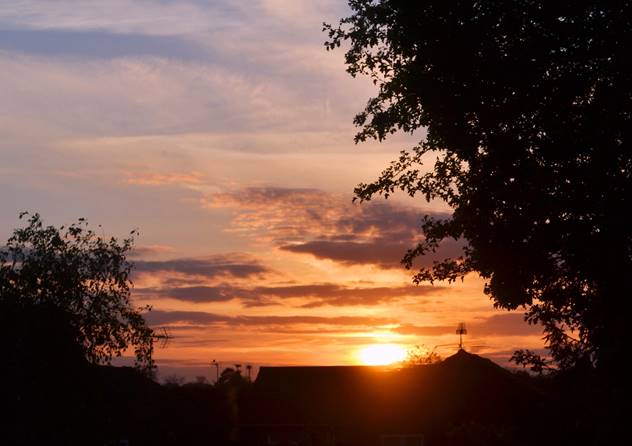
Sunset over Prestwood May 2014